
Resume Writer vs ChatGPT: What AI Gets Right (And What It's Missing)
ChatGPT can help you write a better resume, but it cannot independently determine the strongest career story to tell. It is excellent at improving language, identifying keywords, and tailoring existing content. What it often misses is strategy: what makes you different, which parts of your experience matter most, and how to position you for what comes next.
One of the most common questions I hear these days is, “Should I use ChatGPT for my resume?” My answer usually surprises people because I don’t discourage it. In fact, I think most job seekers should experiment with AI.
If you’re struggling to get started, staring at a blank page, or trying to figure out how to describe an accomplishment, ChatGPT can be incredibly helpful. It can:
Improve grammar
Identify keywords
Rewrite awkward bullet points
Help tailor your resume to a job description in minutes
Those are all good things.
What I find interesting is that the conversation around AI and resumes is often framed as a battle. It's ChatGPT versus resume writers. Technology versus humans. One side insists AI is replacing resume writers, while the other side insists AI is useless. In my experience, neither position is particularly accurate. The reality is much more nuanced. AI is a tool, and like any tool, it's exceptionally good at certain things and surprisingly weak at others.
After working with more than 1,500 professionals over the past decade, I've noticed something fascinating: Resumes are getting better and worse at the same time. They're cleaner, more polished, and generally better written than they were five or ten years ago. Yet they're also becoming increasingly generic. Many of the resumes landing in my inbox sound remarkably similar, even when the candidates come from completely different industries, backgrounds, and levels of experience.
That's because AI is doing exactly what it was designed to do. It analyzes patterns, identifies common language, and produces content that is statistically likely to work. The problem is that when hundreds of thousands of people are using the same tools and asking similar questions, the output begins to converge. The language becomes familiar. The structure becomes predictable. The resumes become interchangeable.
This doesn't mean AI-generated resumes are bad. Quite the opposite. Most AI-generated resumes are perfectly competent. The issue is that competence is no longer enough. When employers are reviewing hundreds of applications, they're not looking for the candidate who sounds exactly like everyone else. They're looking for someone who stands out for the right reasons. That's where the conversation becomes much more interesting.
Should I Use ChatGPT for My Resume?
Let's answer the question directly. Yes, you should absolutely use ChatGPT for your resume. If you're trying to improve wording, identify ATS keywords, tailor content to a specific role, or transform a rough draft into something more polished, AI can save you an enormous amount of time. Many of my own clients have already experimented with ChatGPT before they reach out to me, and I think that's a smart approach.
What AI does particularly well is help people overcome the mechanics of writing. Most professionals are far better at doing their jobs than they are at describing what they do. Ask a marketing executive to lead a team, launch a campaign, or build a strategy and they'll thrive. Ask that same person to summarize twenty years of accomplishments on two pages and suddenly they're stuck. AI can help bridge that gap by turning scattered thoughts into coherent language.
The challenge is that writing has never really been the hardest part of resume writing. Most people assume it is because the final deliverable is a document. Naturally, they focus on the words. They assume that if the wording is strong enough, the resume will be effective. But after years of doing this work, I've come to believe that writing is only a small piece of the equation. The bigger challenge is figuring out what story you're trying to tell in the first place.
A resume isn't simply a summary of your career. It's a marketing document.
More importantly, it's a positioning document.
Its purpose isn't to perfectly document every role, responsibility, or accomplishment you've ever had.
Its purpose is to persuade someone that you're the right person for a future opportunity.
That's a very different objective, and it's where AI often struggles.
Why Most AI-Generated Resumes Sound the Same
One of the reasons recruiters and hiring managers are becoming increasingly skeptical of AI-generated resumes has nothing to do with AI detection software. In fact, the question "Can recruiters tell if a resume was written by AI?" is often the wrong question. The real issue isn't whether they can detect AI. The issue is whether they can detect generic language.
Most recruiters aren't sitting around trying to figure out whether you used ChatGPT. They don't care. What they care about is whether your resume captures their attention and communicates value. Unfortunately, many AI-generated resumes rely on the same language patterns, the same buzzwords, and the same generic descriptions that have been circulating through resumes for years.
When every leader is a "strategic executive," every marketer is "results-driven," every designer is a "creative problem solver," and every project manager excels at "cross-functional collaboration," those phrases stop meaning anything. They become background noise. The candidate may be highly qualified, but the resume fails to communicate what makes them different.
This is one of the biggest limitations of AI. It excels at identifying common patterns because common patterns are literally what it's trained on. The problem is that standing out in a job search often requires moving beyond the common pattern. It requires understanding what makes a candidate unique and highlighting that difference in a meaningful way.
I've seen incredibly talented professionals undersell themselves because their resumes focused on responsibilities rather than impact.
I've seen executives bury their strongest accomplishments beneath generic summaries.
I've seen career changers fail to recognize that their seemingly unrelated experience was actually their greatest differentiator.
These are not writing problems. They're positioning problems.
Resume Writer vs ChatGPT: The Real Difference
When people compare a professional resume writer to ChatGPT, they usually assume the comparison comes down to writing quality. In reality, that's the least interesting part of the conversation. AI can write. It can write surprisingly well. The question isn't whether it can produce polished content.
The question is whether it can uncover the insights that make that content meaningful.The biggest difference between ChatGPT and a professional resume writer is perspective. AI only knows what you tell it. It works with the information you provide and attempts to organize it as effectively as possible. A resume writer, on the other hand:
Challenges assumptions
Asks questions
Identifies patterns
Helps uncover stories that may not be obvious to the client themselves
This is why my process looks very different from what most people expect. Before I write a single word, clients complete a Personal Branding Inventory and an Impact & Contributions Inventory. We analyze target job descriptions, identify recurring themes, and look for patterns across their career. I'm not simply gathering information. I'm trying to understand who this person is, how they create value, and what makes them different from other candidates with similar credentials.
You can learn more about this approach on my About page, but the short version is that I've always viewed my work as personal branding disguised as resume writing. The resume is the deliverable, but the real work happens long before the writing begins. It happens during the discovery process, when we start uncovering strengths, accomplishments, leadership themes, and differentiators that may have been hiding in plain sight.
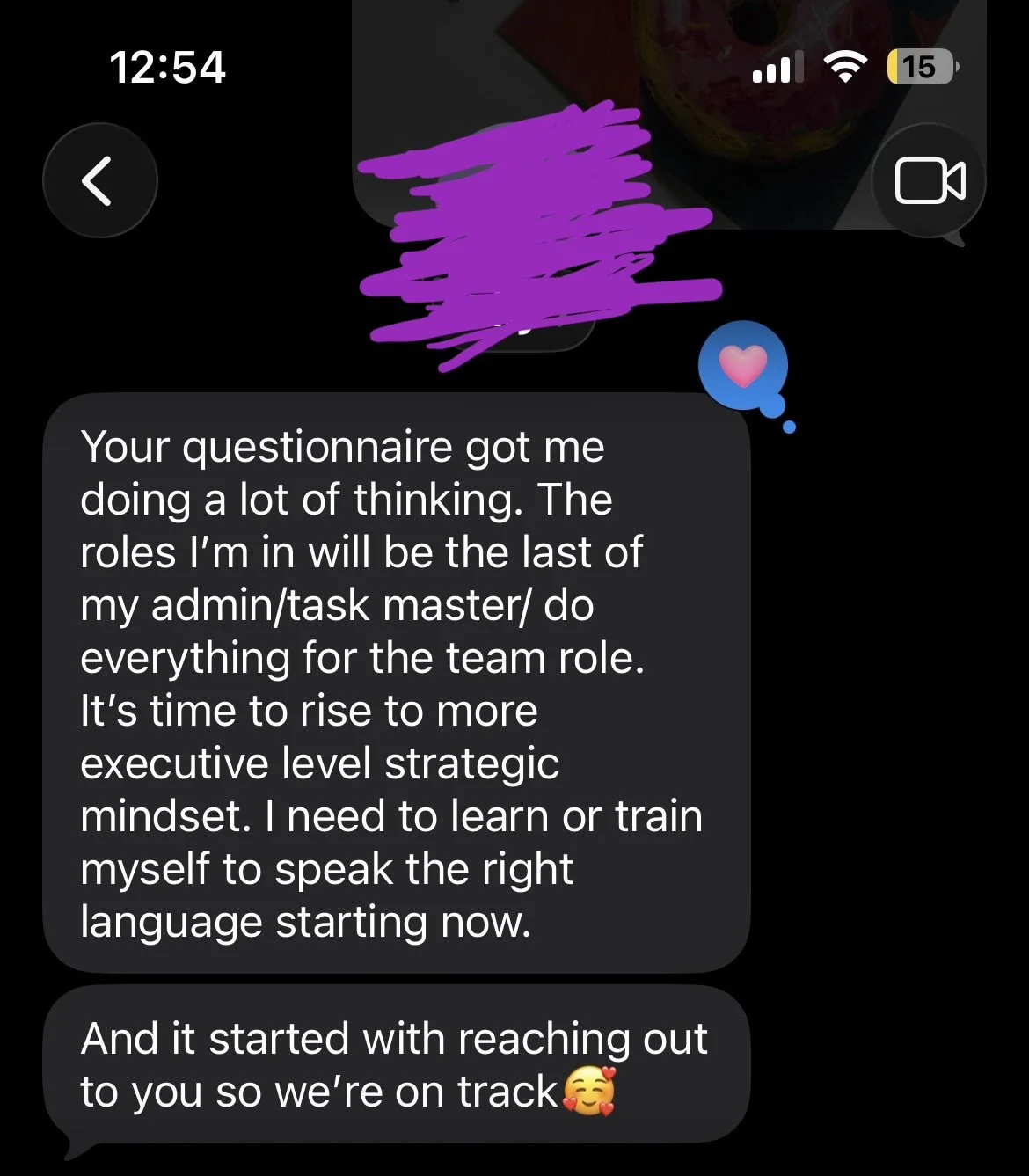
Text from a recent client. And this is very common feedback!
Often, the most valuable insight has nothing to do with writing at all. It's the moment a client realizes they've been positioning themselves incorrectly. A designer discovers they're not really selling design skills; they're selling strategic thinking and business impact. An operations leader realizes their greatest strength isn't efficiency; it's change management. A marketing executive recognizes that the common thread throughout their career has been transformation rather than promotion.
Those insights rarely emerge from a prompt.
Can Recruiters Tell if a Resume Was Written by AI?
The short answer is sometimes, but not for the reasons people think.
Recruiters aren't typically rejecting candidates because they suspect AI was involved. What they notice is when a resume feels generic, vague, or disconnected from the candidate's actual experience. They notice when the language sounds polished but lacks substance. They notice when every accomplishment feels interchangeable with the accomplishments on the twenty resumes they reviewed before yours.
A strong resume feels specific.
It reflects a person's unique career path, accomplishments, leadership style, and strengths.
It contains details that could only belong to that candidate.
It helps the reader understand not just what the person has done, but why it matters and what they might contribute in the future.
Ironically, many of the strongest resumes I see today are created using a combination of AI and human strategy. The candidate uses AI to improve wording, identify gaps, and refine content. Then they apply critical thinking, perspective, and positioning to ensure the story is actually compelling. That's a far more effective approach than relying entirely on either one.
The Future of Resume Writing Isn't About Writing
As AI continues to improve, professionally written resumes will become easier and easier to create. That's not a threat to the industry. If anything, I think it's a positive development. Strong writing should be accessible. People should have tools that help them communicate more effectively.
What I believe will become increasingly valuable is strategy. As writing becomes commoditized, positioning becomes more important. The ability to:
Identify someone's differentiators
Clarify their value proposition
Align their experience with their future goals
becomes the real competitive advantage.
That's why I don't spend much time worrying about AI replacing resume writers. The part of my work that clients value most isn't the writing itself.
It's the clarity.
It's the perspective.
It's the ability to identify patterns they couldn't see on their own and transform those insights into a compelling narrative.
The resume is simply where that strategy becomes visible.
Ready to Take Your ChatGPT Resume to the Next Level?
If you've already used ChatGPT to write or improve your resume, that's fantastic. You're probably further ahead than many job seekers. The next question isn't whether the writing is good enough. The next question is whether you're telling the right story.
Does your resume clearly communicate what makes you different?
Does it position you for the roles you actually want?
Does it highlight your strongest accomplishments and connect them to your future goals?
Does it reflect your personal brand, or does it sound like everyone else in your industry?
If you're not sure, that's exactly where I can help. Start with a Resume Review if you'd like an objective assessment of your current document, or explore my Resume Writing Services if you're ready for a deeper strategic process. You can also read through my client testimonials to see how others have experienced the process, or contact me directly to discuss your goals.
Use ChatGPT. Use every tool available to you. Just remember that writing is only part of the equation. In a world where everyone has access to the same technology, the candidates who stand out won't be the ones with the fanciest prompts. They'll be the ones telling the clearest, most compelling, and most strategically aligned story.
Frequently Asked Questions
-
Yes. ChatGPT can help improve wording, identify keywords, tailor content to job descriptions, and overcome writer's block. However, it cannot determine your unique differentiators, uncover career themes, or create a positioning strategy for where you're trying to go next.
-
Not always. Most recruiters are not using AI-detection software. What they often notice is generic language, repetitive buzzwords, and resumes that sound similar to dozens of others they've reviewed.
-
Often, yes. Many professionals come to me with AI-generated resumes that are well-written but lack clear positioning. The value of a resume writer is not just improving the writing—it's helping identify what makes you different and strategically aligning your experience with your target roles.
-
ChatGPT helps organize and rewrite information. A professional resume writer helps uncover career themes, identify differentiators, build a personal brand, and position you for future opportunities.
-
Yes. ChatGPT can help identify and incorporate relevant keywords from job descriptions. However, ATS optimization alone does not guarantee interviews. Your resume must also clearly communicate value, impact, and relevance to the role.
-
ChatGPT can help rewrite content, but career changes typically require a deeper positioning strategy. The challenge is often determining which experiences are most relevant to the new direction and how to tell that story effectively.
If you want a resume that reflects who you are and where you're going, here’s where to start
👉 Start Your Resume
👉 Get your Resume Audit
👉 View Samples
👉 Explore the Full FAQ